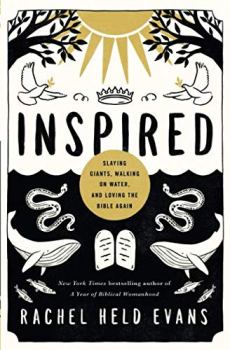
 I’ll admit that I have read all of Rachel Held Evan’s books. It has been enjoyable to see how she has evolved as a writer. In many ways her faith journey of construction, deconstruction and reconstruction has been similar to my spiritual journey as well. This book is entitled “Inspired: Slaying Giants, Walking on Water and Loving the Bible Again”.
In the introduction, Evans reminisces that “Gone was the comforting storybook of my childhood, the useful handbook of my adolescence, and the definitive answer book of my college years. The Bible in my twenties served only as a stumbling block, a massive obstacle between me and the God I thought I knew.” (p. xvii). The Bible evolved for her over time into a book that was disturbing and troubling at best. She needed to deconstruct her faith from her past and reconstruct it into something that made sense to her with all her questions, doubts and concerns. Evans comes to terms stating that “From the rich history of Jewish interpretation, I learned the mysteries and contradictions of Scripture weren’t meant to be fought against, but courageously engaged, and that the Bible by its very nature invites us to wrestle, doubt, imagine, and debate.” (p. xix).
Evans then breaks down her book into sections that deal with specific themes that emerge from the Bible. She starts with Origin Stories. This is related specifically to the Creation Story in Genesis. Growing up I was taught that this was scientific fact. At Liberty University I even had to take a Creation Science class that attempted to prove a literal 7-day creation and young earth theory. Evans says that, “Contrary to what many of us are told, Israel’s origin stories weren’t designed to answer scientific, twenty-first-century questions about the beginning of the universe or the biological evolution of human beings, but rather were meant to answer then-pressing, ancient questions about the nature of God and God’s relationship to creation.” (p. 9). In ancient days there were many different types of creation stories out there from pagan religions. The creation story that the Jews had stood in stark contrast those. Evans concludes this section in commenting that “The creation account of Genesis 1, in which God brings order to the cosmos and makes it a temple, is meant to remind the people of Israel, and by extension, us, that God needs no building of stone from which to reign, but dwells in every landscape and in the presence of the humble will make a home. (p. 19).
In the next section Evans tackles Deliverance Stories with a view towards liberation theology. She says that “This crimson thread of justice has been traced by marginalized people through the ages, their struggle for freedom sustained by Scripture’s call to honor the poor, welcome the stranger, and liberate the oppressed.” (p. 39). Evans sees that scripture will be seen differently from the oppressed than the privileged. She goes on to say that “Anytime the Bible is used to justify the oppression and exploitation of others, we have strayed far from the God who brought the people of Israel out of Egypt, ‘out of the land of slavery’ (Exodus 20:2). This is why it’s especially important for those of us who come to the Bible from positions of relative social, economic, and racial privilege to read its stories alongside people from marginalized communities, past and present, who are often more practiced at tracing that crimson thread of justice through its pages. (p. 41). And then I love Evans statement here in that “They say art should afflict the comfortable and comfort the afflicted. I think the same is true for Scripture. For centuries the Bible’s stories of deliverance have offered comfort to the suffering and a challenge to the privileged. (p. 43). At this time in America it is a shame to see how the poor and marginalized are being treated. The church, of all things, should be in the trenches learning form them as well as serving and lifting up those who are on the margins of society. She concludes by saying that “the question we have to ask ourselves is this: are we reading with the prejudice of love, with Christ as our model, or are we reading with the prejudices of judgment and power, self-interest and greed? Are we seeking to enslave or liberate, burden or set free?” (p. 56). We must evaluate and take a good, hard look at where we stand with the oppressed in our communities, in our country and around the world. Have we become a help to them, or do we ignore them or vilify them since they are different from us?
The next section deals with the War Stories found in scripture. Evans wrestles with the text of scripture that are tough to reconcile with a loving God. She states that we need “to engage the Bible’s war stories with a bit more humility and introspection, willing to channel some of our horror over atrocities past into questioning elements of the war machines that still roll on today.” (p. 76). Evans sees Jesus as the culmination of the plan of God all along in stating that “if the God of the Bible is true, and if God became flesh and blood in the person of Jesus Christ, and if Jesus Christ is – as theologian Greg Boyd puts it – ‘the revelation that culminates and supersedes all others,’ then God would rather die by violence than commit it. The cross makes this plain. On the cross, Christ not only bore the brunt of human cruelty and bloodlust and fear, he remained faithful to the nonviolence he taught and modeled throughout his ministry.” (p. 77). Jesus is seen as the perfect representation of who God is. Evans concludes this section in saying that “God save me from the day when stories of violence, rape, and ethnic cleansing inspire within me anything other than revulsion. I don’t want to become a person who is unbothered by these texts, and if Jesus is who he says he is, then I don’t think he wants me to be either. There are parts of the Bible that inspire, parts that perplex, and parts that leave you with an open wound.” (p. 79). Evans does a great job in wrestling with the passages of scripture that are disturbing. Greg Boyd is an excellent source in one who has struggled with the war stories and how the God of the Old Testament can be reconciled with the God of the New Testament seen in the person and work of Jesus.
The next section of the book tackles Wisdom Stories. Evans says that “In the paradox of Job, the vulnerability of the Psalms, and the angst of Ecclesiastes, God’s children are invited into the whirlwind, to cry out and question, to demand and debate, and to consider the big questions of life without resting in easy answers. The Bible reflects the complexity and diversity of the human experience, with all its joys and sorrows.” (p. 99). She continues in stating that “When God gave us the Bible, God did not give us an internally consistent book of answers. God gave us an inspired library of diverse writings, rooted in a variety of contexts, that have stood the test of time, precisely because, together, they avoid simplistic solutions to complex problems. It’s almost as though God trusts us to approach them with wisdom, to use discernment as we read and interpret, and to remain open to other points of view.” (p. 104). Evans concludes this section saying that “The Psalms are, in a sense, God’s way of holding space for us. They invite us to rejoice, wrestle, cry, complain, offer thanks, and shout obscenities before our Maker without self-consciousness and without fear. Life is full of the sort of joys and sorrows that don’t resolve neatly in a major key. God knows that. The Bible knows that. Why don’t we?” (p. 111). God is a big God and he can take on all of our emotions from praise to cursing. The wisdom literature shows us that life isn’t made up of simple answers and easy cause and effect solutions. Life can be messy and complicated, yet God is still with us in the good and bad times.
The next section was one of my favorites. It tackles the Resistance Stories. This helped me to better understand the resistance between the Kingdom and the Empire throughout scripture. Evans begins with saying “One of the most important questions facing the people who gave us the Bible was: How do we resist Babylon, both as an exterior force that opposes the ways of God and an interior pull that tempts us with imitation and assimilation. . . . It is in this sense that much of Scripture qualifies as resistance literature. It defies the empire by subverting the notion that history will be written by the wealthy, powerful, and cruel, insisting instead that the God of the oppressed will have the final word.” (p. 118). Knowing this, we need to take heed in the fact that we are a part of the most powerful nation on the planet. In light of this, Evans states that “Americans, particularly white Americans, have a hard time catching apocalyptic visions when they benefit too much from the status quo to want a peek behind the curtain. When you belong to the privileged class of the most powerful global military superpower in the world, it can be hard to relate to the oppressed minorities who wrote so much of the Bible. . . . The fact is, the shadow under which most of the world trembles today belongs to America, and its beasts could be named any number of things – White Supremacy, Colonialism, the Prison Industrial Complex, the War Machine, Civil Religion, Materialism, Greed.” (p. 125). Evans builds on this in commenting that “There’s just no denying that the very things for which Israel was condemned by the prophets – gross income inequality, mistreatment of immigrants and refugees, carelessness toward life, the oppression of the poor and vulnerable, and the worship of money, sex and violence – remain potent, prevalent sins in our culture.” (p. 127). There is hope though! Evans concludes that “Jesus takes the Resistance beyond prophecy, beyond songs of hope and lamentation, beyond satire and mockery, and beyond apocalyptic visions to declare the inauguration of a new kingdom. With his birth, teachings, death and resurrection, Jesus has started a revolution.” (p. 140). We as a church need to be involved in justice issues. It is in relating to the poor and oppressed that we can see Jesus in a way that we never could in the comfort of our middle class bubble that many of us live in.
The next section deals with Gospel Stories. Evans goes into telling the stories of many people who have all been effected by the Gospel stories in their various contexts. Evans then states that “The gospel means that every small story is part of a sweeping story, every ordinary life part of an extraordinary movement. God is busy making all things new, and the life, death, and resurrection of Jesus has opened that work to everyone who wants in on it. The church is not a group of people who believe all the same things; the church is a group of people caught up in the same story, with Jesus at the center.” (p. 157). As small as we may feel at times, we are all invited to be a part of a much bigger story through God.
The next section deals with the miracle stories which Evans titles the Fish Stories. Evan says that “The miracles of Jesus prefigure a future in which there is no more suffering, no more death, no more stigmatization, no more exclusion, no more chaos. They show us what it looks like for God’s will to be done on earth as it is in heaven, and they invite us to buy into that future now, with every act of compassion and inclusion, every step toward healing and reconciliation and love.” (p. 185). This is a beautiful way of looking at the miracle passages in that Jesus is showing us glimpses of how a broken world can look when it is healed or made right.
The final section of Biblical literature that Evans tackles is the letters to the church which she calls Church Stories. Evans says that “the letters of Paul weren’t written by a crotchety misogynist intent on regulating the behaviors of women and minorities for millennia to come, nor were they composed by a godlike philosopher disseminating soteriological truths into the universe from an ivory tower. The apostle Paul was a smart, worldly, and broad-minded Jew who had been utterly transformed by what he saw as his singular mission in life: to preach the gospel of Jesus Christ to the Gentiles and welcome them in to Israel’s story. In pursuit of that mission, Paul was determined to break down every religious, ethnic, and cultural barrier that stood in the way.” (p. 210). Paul was interested in getting the gospel out to as many Gentiles as possible within his lifetime. With every type of culture he came into there were certain things that could either help or hinder the spread of the gospel. It is within this context that we need to read the church stories.
Overall, I just love Rachel Held Evans! She is a great writer who has gone through the construction of her faith within a very conservative, evangelical setting, deconstructed that in her 20’s and is now in the process of reconstructing her faith as an adult. Her journey has had a lot of similarities to mine. But with this book, I really appreciate how she can put into words things I have thought for quite a while. I still wrestle at times with my conservative, evangelical roots and where my faith journey has taken me now. I appreciate authors like Rachel Held Evans showing their vulnerability and process that they have gone through to reconstruct their faith. I highly recommend any of the books Evan’s has written. Each one gets better and better.
 When I was in high school I still remember taking my girlfriend (who is now my wife) to go see a movie at the local mall. All I knew about the movie was that it was a Steven Spielberg movie starring Michael J. Fox. These were two very good reasons to see a movie in 1985. Little did I know what I was in for. It turned out to be one of my favorite ‘80’s movies. The concept of going back in time 30 years to help change the future was a great concept. Of course, Marty McFly was trying to help his parents who were teenagers in 1955. But I often wonder, what would I do if I could go back 20-25 years and find the young version of myself just starting out in ministry. Knowing what I know now, what would I say to the 1990’s Scott just starting out in youth ministry?
 Once again, I heard a great speaker at the Global Leadership Summit back in August 2018. They so inspired me to go out and buy some of his books! This one is called “Start With Why: How Great Leaders Inspire Everyone to Take Action” by Simon Sinek. It was a great read in explaining how great leaders start with the “why” when it comes to being successful. So many businesses start with what they do and how they do it without wrestling with why they do what they do. When you discover your “why” that will help to inspire and empower the people who work for you. And the answer to WHY is not just about making money. It is about what inspires people to want to give their best effort towards your cause.
 I heard Erwin McManus for the first time at the Global Leadership Summit in August 2018. He was by far, the most passionate and dynamic speaker of the whole event. He spoke about the fact that he was diagnosed with cancer a while back. As a result of his battle with cancer, this has helped to put things into better perspective as to living his life in order to make the most impact possible.
 There is enough negativity out there directed at youth ministry that when I saw the title of this book I knew I just had to get it! Mark Oestreicher has been in the “business” for quite a while now. I have aged in my ministry to youth following the career and writings of Marko. And just about anything he has written on the topic of youth ministry has been very thought provoking and enlightening.
 Lately I have been feeling a little discouraged when it comes to my ministry. Not a big deal, nor is it something I really want to get into here, but I do want to share some God moments I have had over the past week where God clearly showed Himself to me as an encouraging sign that things are happening with our youth.
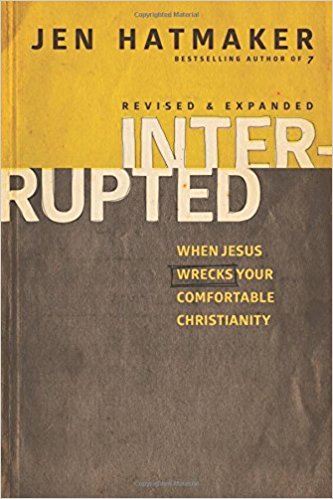 What happens when God messes up your comfortable Christian life? Author Jen Hatmaker takes you on a personal journey of how God did just that for her and her family. She begins by recognizing the facts about poverty around the world in contrast to a comfortable Christianity that so many of us practice. Through the influences of Shane Claiborne writings, and the promptings of the Holy Spirit, Jen was challenged to step out of her comfort zone and let her faith get messy. She states that “I am still stunned by my capacity to spin Scripture, see what I wanted, ignore what I didn’t and use the Word to defend my life rather than define it.” (p. 5). The sad fact is that I believe that many American Christians do approach their faith like this. Jesus came to radically change our lives. Too often we want Jesus in our lives but on our terms, not His. We don’t want Him to ruin the life we have created for ourselves. Jen points out that “Americans living in excess beyond imagination while the world cries out for intervention is an unbearable tension and utterly misrepresents God’s Kingdom.” (p. 31). Jen balances this out though, not trying to lay a big guilt trip on her readers, but instead she is trying to wake us up to many of our realities. Jen comments “Please don’t hear me say that America stinks and all her citizens are narcissists. It’s just that most of us have no concept of our own prosperity. Nor do we have an accurate understanding of the plight of the rest of the world. Our perspective is limited, and our church culture is so consumer oriented that we’re blinded to our responsibility to see God’s kingdom come to ‘all nations’. . . . We stand at the intersection of extreme privilege and extreme poverty, and we have a question to answer: Do I care?” (p. 34-35).
 Scott Russ