Andrew: Bringing People to Jesus

One of the greatest joys of being a pastor is to see someone come to know Jesus and watch the Holy Spirit transform a person into a Christ-follower. This is what energizes me and empowers me to continue doing what I am doing. I especially love watching teenagers engage in the faith because they are at a critical stage of life where God can do the impossible in their lives as they discover their giftedness and make important decisions as to what they would like to do with their lives. It is what gets me up every day and what brings me back to the church each and every day: to see the life-transforming power of Jesus change someone from the inside out.

If you have been paying attention to the news lately things just seem to be crazy right now. It is easy to get overwhelmed and feel despair. But as a follower of Jesus how do we rise above all that is going on? What is the proper response? When we are faced with personal and social issues what is our knee-jerk reaction?

I know that when it comes to social issues, it is good for us to consider better rules or laws for everyone to follow in order for there to be more justice and equality. But even if we had the best, most well thought-out laws that protected everybody would that finally take care of all our social ills?

I would propose that with all the right laws we would still face problems because the external laws do not change the heart! We see this with the Israelites in the Old Testament. And their laws were not man-made! They can from God Himself! We believe that the most powerful change factor that we profess to is the radical, life-transforming work of the Holy Spirit which comes through faith in Jesus. Quite simply, we call this the Gospel, the Good News. That despite whatever social, political, or personal ills we might be facing, Jesus can come into any situation and bring healing, hope, restoration and power that transcends our laws and politics. Jesus is our King and God’s Kingdom is our primary identity. What if the church acted like this and believed this 100%?

I would like to do a case study today. I want us to look at one of Jesus’ disciples named Andrew. He is mentioned just a handful of times throughout Scripture but every time he is mentioned it is important for us to observe his actions and see how he responds to his circumstances.

Let’s begin in the Gospel of John.

CASE STUDY: Andrew: Bringing People to Jesus

John 1:35-42 The next day John was there again with two of his disciples. 36 When he saw Jesus passing by, he said, “Look, the Lamb of God!”

37 When the two disciples heard him say this, they followed Jesus. 38 Turning around, Jesus saw them following and asked, “What do you want?”

They said, “Rabbi” (which means “Teacher”), “where are you staying?”

39 “Come,” he replied, “and you will see.”

So they went and saw where he was staying, and they spent that day with him. It was about four in the afternoon.

40 Andrew, Simon Peter’s brother, was one of the two who heard what John had said and who had followed Jesus. 41 The first thing Andrew did was to find his brother Simon and tell him, “We have found the Messiah” (that is, the Christ). 42 And he brought him to Jesus.

Jesus looked at him and said, “You are Simon son of John. You will be called Cephas” (which, when translated, is Peter).

In this story we see that Andrew was a disciple of John the Baptist. When Jesus happened to come in contact with John and his disciples, John called Jesus “the Lamb of God”. This piqued Andrew’s interest enough to go and follow Jesus for the day. After processing his experience with Jesus, what I want you to notice in each one of these passages 3 things:

1) What is Andrew’s first reaction,

2) Who is the focus group that he is in contact with,

3) and what are the future consequences, or ripple effects of his interaction with the people in the story.

In this story we just read, did you catch what Andrew’s immediate reaction was after spending the whole day with Jesus? He went right away to his brother Simon to tell him that he found the Messiah. This is Simon who’s name Jesus changed to Peter.

So what is the focus group here? We see that Andrew’s first reaction was to share with his immediate family.

And what are the consequences that we know of as a result of Peter meeting Jesus? Peter ended up being one of the primary disciples that Jesus spent the most time with. Peter was the one who denied Jesus three times and yet after the resurrection Jesus sought Peter out and affirmed him three times to feed his sheep. Peter was called the rock that the church would be built on. Peter was a primary figure throughout the book of Acts who launched the church movement. He wrote some of the letters found in the Bible. We would not be where we are at today as the church of Jesus Christ if it weren’t for the courageous faith of Peter boldly spreading the message of Jesus to thousands of people. Why? All because of Andrew who was willing to introduce his brother to Jesus. If Andrew did not act on that impulse just try to imagine the New Testament without the presence of Peter.

Let’s take a look at another story found in the Gospel of Mark.

Mark 1:29-34 As soon as they left the synagogue, they went with James and John to the home of Simon and Andrew. 30 Simon’s mother-in-law was in bed with a fever, and they immediately told Jesus about her. 31 So he went to her, took her hand and helped her up. The fever left her and she began to wait on them.

32 That evening after sunset the people brought to Jesus all the sick and demon-possessed. 33 The whole town gathered at the door, 34 and Jesus healed many who had various diseases. He also drove out many demons, but he would not let the demons speak because they knew who he was.

Andrew is with Jesus and the rest of the disciples as they leave the synagogue and go to his house. As they come to Andrew’s home it was discovered that Peter’s mother-in-law was sick with a fever. Now notice what was the first reaction of Andrew and his brother Peter in realizing that their relative was sick. Andrew, with Peter, brings Jesus into the situation. Now this circumstance is different from our first story. This is not necessarily about meeting Jesus for the first time more than it is about Jesus entering into a major issue and bringing peace, healing and wholeness to it.

Imagine if we did that with all the personal and social ills we are experiencing in our country right now. When we face a major problem in our life or community our immediate reaction ought to be to invite Jesus into the problem.

So, who was our focus group being brought to Jesus here? It was Andrew’s extended family. So not only did he introduce his primary family to Jesus but also distant relatives. We see the circle expanding here.

And then what was the consequences of Andrew bringing Jesus in to heal Peter’s mother-in-law? Many, many other people came to find healing through Jesus, both physical and spiritual healing. We can never underestimate the ripple effect that can be caused by bringing Jesus into every situation we find ourselves with whether it be personal or social.

Our next Scripture passage comes from the Gospel of John.

John 6:5-11 When Jesus looked up and saw a great crowd coming toward him, he said to Philip, “Where shall we buy bread for these people to eat?” He asked this only to test him, for he already had in mind what he was going to do.

Philip answered him, “It would take more than half a year’s wages to buy enough bread for each one to have a bite!”

Another of his disciples, Andrew, Simon Peter’s brother, spoke up, “Here is a boy with five small barley loaves and two small fish, but how far will they go among so many?”

10 Jesus said, “Have the people sit down.” There was plenty of grass in that place, and they sat down (about five thousand men were there). 11 Jesus then took the loaves, gave thanks, and distributed to those who were seated as much as they wanted. He did the same with the fish.

Many of you are familiar with this passage. This is where Jesus miraculously feeds the 5,000 people with 5 loaves and 2 fish. But notice what happened. Jesus wanted to offer food to the crowd. He threw out the request to the disciples to see what would happen. Keep in mind that they would have seen Jesus perform many miracles already. What is the reaction of the disciples here?

Philip complains and the others remain silent. I can relate to Philip. I can imagine him thinking “Are you crazy? Do you know how much that would cost to feed everyone?”

But notice Andrew here! He is the only disciple once again, bringing someone to Jesus. He brings a child to him who has a basket with bread and fish in it. At the very least, Andrew is thinking of “Who can I bring to Jesus in this situation?”.

Who is the focus group here? It is a child. So what I gather here is that the circle that Jesus influences in Andrew’s life is not just immediate and extended family but now it is breaking out to being inter-generational, old and young alike.

What was the consequence of Andrew bringing this child to Jesus? He was able to take what the boy had and miraculously multiply it to satisfy the hunger of all the people. It is just another illustration in Scripture and in our lives where God can take what little we have and multiply it in ways we could never imagine.

Our final Scripture comes from the Gospel of John. Once again, pay attention to Andrew and the ripple effects of what he does.

John 12:20-22 Now there were some Greeks among those who went up to worship at the festival. 21 They came to Philip, who was from Bethsaida in Galilee, with a request. “Sir,” they said, “we would like to see Jesus.” 22 Philip went to tell Andrew; Andrew and Philip in turn told Jesus.

Philip was at a festival and some Greeks approached him wanting to meet Jesus. It appears that Jesus wasn’t immediately available so what does Philip do? He takes this situation to Andrew for help. Andrew took Philip, with the Greeks, and introduced them to Jesus. Now Jesus goes on to give a lesson, but I want us to focus in on what Andrew did. He modeled to Philip what it was like to introduce people to Jesus.

What is the focus group here? It is the Greeks. Or more radically speaking it is the non-Jewish people. This shows us the multi-cultural nature of Jesus. He not just the Messiah of the Jews but for all the nations.

And what is the future consequences of Andrew’s actions here? In the book of Acts we see Jesus commission his followers to go and make disciples of all the nations and then He ascends into heaven. Many of the followers continue the work of the Gospel in Israel until persecution breaks out and scatters everyone. As we follow Philip in Acts, chapter 8, we see that he goes into Samaria to proclaim the good new of Jesus. Now if you know anything about Samaritans these are people who the Jewish people had no love for. Samaritans we looked down upon as second-class citizens. Yet Philip, with his experience with the Greeks, had no problem introducing the Samaritans to Jesus. Many miracles happened and we are told that there was much joy in that city.

Now if that weren’t enough, God used Philip to go and speak to the Ethiopian eunuch. Here is our first reference to anyone from the African continent coming to know Jesus. The Ethiopian was reading a passage from Isaiah that was a prophecy about all that Jesus just accomplished at the cross. Philip had the honor of sharing the good news of Jesus Christ to this Ethiopian who immediately put his faith in Jesus and asked to stop the chariot they were riding in so that he could be baptized. Amazing!

So who is the focus group here? It is the Ethiopian. When we combine that with the Greeks we see that this focus group comprises of those who are different that you. For Andrew, the gospel of Jesus came first to his immediate family, his extended family, it was multi-generational for the young and the old, and it is now multi-cultural. It transcends all cultures, races and people groups.

The consequences here are that Andrew is responsible for missionary efforts through the work of Philip to a wide cross-section of non-Jewish people both Greek and African.

So, what do we make of all of this? 2020 has proven to be a very tough year for all of us. I would encourage every one of you to be careful about all the directions and causes that could potentially pull you into certain camps. Our primary identity is in Jesus Christ and we are representatives of His Kingdom here on earth as it is in heaven. It is our responsibility to invite Jesus into all of our situations, our issues, and our relationships. We must be vigilant about this.

We have been given the task of making disciples of all the nations. This seemed to come naturally to Andrew. Was there a person hurting, or a social situation begging for a solution, or just a friend or relative who was going through something? Andrew’s immediate reaction was to figure out how Jesus could come into the situation or relationship and breath His power into every situation. And guess what? Jesus did not disappoint! Jesus brought healing, salvation, and multiplication into every situation.

How are you with your relationship with Jesus? Have you considered how he can speak into your personal life, your social life, your political life? Or are you limiting the potential of what Jesus could do through you?

If it weren’t for Andrew there would not be Peter or Philip. The missionary efforts of these two stalwarts is legendary. Yet none of it would be possible if Andrew didn’t introduce them to Jesus first. Never underestimate the impact that God can do through you simply by inviting Jesus into your situations and your relationships. How can you step out in faith and trust Jesus to use you to impact others?

We have the same Holy Spirit power within us that the believers had in the New Testament. The only problem is that we here, in 21st century America, have domesticated our faith and relegated it to our “private” life. Many of us are guilty of draining the power out of our faith. It is time for us to be brave like Andrew and invite Jesus into all areas of our lives and relationships.

As we are in the midst of a very, very crazy political year imagine if our connection to Jesus was what shined through all of our thoughts, feelings, emotions and relationships. This is who we are called to be. Kingdom people who are reflecting the transforming power of Jesus Christ. We can change a lot of laws to try and create a more just society, as we should, but only Jesus can transform the heart and mind of people as we are invited into his kingdom here and now. Let’s not lose focus of that and make sure that this is our primary identity above all else.  

John Wesley got it. He said,

“Give me one hundred preachers who fear nothing but sin and desire nothing but God, and I care not whether they be clergymen or laymen, they alone will shake the gates of Hell and set up the kingdom of Heaven upon Earth.”

He knew that if he had a bunch of people similar to Andrew, willing to take the good news out to everyone, the world would be forever altered as the Kingdom of God would continue to expand and the effects of Hell would be destroyed.

May we enter into this Summer allowing the Holy Spirit to change and transform us to be more like Andrew, introducing Jesus to all types of people and situations that we encounter. How can you do this right now?

Who are you going to impact?

How are you living into being a disciple of Jesus?

Step out of your comfort zone and allow God to use you to impact others through you. You may never know what kind of ripple effects that the Holy Spirit may use with your ability to bring Jesus into all of your situations. Think about it. Pray about it. And do it, trusting God to use you in amazing ways! Amen.

A NEW REALITY

Imaging going back in a time machine to December 31, 2019. Everybody is waiting in anticipation for the new year and thinking of what they want to do differently to make their lives better for 2020. Knowing what you know now, how would you advise yourself with the 2019 version of you on what your New Year’s resolutions should look like? Imagine a conversation between your present self and your December 31, 2019 self!

2019 Self: I think I want to try and get in shape and lose some weight!

2020 Self: Um, everyone is going to turn into a couch potato and that will be a goal that will actually be very hard to maintain. Just accept that you are going to gain some weight.

2019 Self: Ok. I think I would like to spend more quality time with my spouse.

2020 Self: Well, in a way, you will have this but more like QUANTITY TIME instead of QUALITY time. You will both be working from home on your couch annoying each other.

2019 Self: Okay, I want to get out more and enjoy the outdoors.

2020 Self: There will be MURDER HORNETS!

2019 Self: I need to spend more time with the kids.

2020 Self: Oh really!?! Wish granted! You will become a homeschool parent!

2019 Self: Wait! What?!? That is not what I was wishing for!

If we are honest with ourselves, 2020 could not be anything we could have every imagined. Our world has been turned upside-down.

Never in my wildest dreams would I have every guessed that we would not be holding graduations as the Cintas Center and having graduations parties all over our communities for the next several weekends.

Never would I have ever guessed we would not be going to Memphis and Mexico for our mission trips.

Never in my wildest dreams would I have ever imagined that church buildings, for the most part, all across out country, would be closed to their parishioners.

I would like to suggest today that we are in a similar situation that the Israelites were in as they were heading into the Promised Land. If you recall, they were enslaved in Egypt. God called and empowered Moses to go and confront the Pharaoh to “Let my people go!” Through a series of plagues, the Israelites were released and sent away to a land that God would provide for them. They were in a transitional time. There was “WHAT USED TO BE” as they were heading to “WHAT IS TO COME” but in the meantime, they were transitioning, they were in-between.

As they came to the land of Canaan, it was time to send out some spies and get a glimpse of what the new land looked like. 12 men were picked out among the tribes. They were given 40 days to scout out the land and come back and give a report.

When they returned they gave their report. The land was amazing but the people there were scary. Fear began to spread throughout the camp. But one person in particular stood up and defied the others. That man was Caleb. He stated that:

READ Numbers 14:7-9

“The land we passed through and explored is exceedingly good. If the Lord is pleased with us, he will lead us into that land, a land flowing with milk and honey, and will give it to us. Only do not rebel against the Lord. And do not be afraid of the people of the land, because we will devour them. Their protection is gone, but the Lord is with us. Do not be afraid of them.”

Caleb had a vision for what God could do through them. Instead of focusing on the immediate fears that the others were consumed with, Caleb believed in God’s strength and power to forge a NEW REALITY for the Israelites. Now Caleb is one of my most favorite Old Testament characters. While everyone was consumed with fear and panic, he was looking forward to a NEW REALITY that God was creating with them. He was able to RISE ABOVE the negativity and stand firm on the possibility that God was doing something new here and it was up to the people to believe and trust in the possibility of this NEW REALITY.

While Caleb’s speech was inspiring and encouraging, look at the reaction he got from his audience. Now keep in mind, these very people are the ones who publicly witnessed all the miracles in Egypt which God used against the Pharaoh and the Egyptians in order to free the Israelites. They were witnesses to the cloud and the pillar of fire leading them through the transitional time. They saw God meet with Moses on Mount Sinai and forge the Law. They have witnessed miracle after miracle, blessing after blessing, and yet, as they look towards the Promised Land, they come to the conclusion that:

READ Numbers 14:2-4

“If only we had died in Egypt! Or in this wilderness!Why is the Lord bringing us to this land only to let us fall by the sword? Our wives and children will be taken as plunder. Wouldn’t it be better for us to go back to Egypt?” And they said to each other, “We should choose a leader and go back to Egypt.”

This BLOWS MY MIND! In light of all that they have seen in the past, they are willing to forget all of that and allow themselves to be consumed with fear and give up on trusting that God was going to create a NEW REALITY for them. Instead, they wanted to GO BACK TO EGYPT! They were afraid for their future and longed to go back to the past with all the oppression and slavery.

Now, I want us to consider our current situation. We are living into trying to figure out this coronavirus pandemic. Depending on who you are listening to, there is a lot of fear out there. And for legitimate reasons.

Losing 100,000 Americans is shocking and appalling. We should be mourning as a nation over the recent losses due to the pandemic as well as the continued acts of

domestic violence,

gun violence,

and racism as seen through the untimely death of George Floyd and Ahmed Aubrey

If this isn’t bad enough, we are heading into a political season where fear is going to be stoked to gain voters like we have never seen before. America is really, really sick right now.

Not just because of a virus,

but mentally,

emotionally,

politically,

spiritually sick, sick, sick.

When we see all that is going on, we have to be careful not to give into the messages of fear and cry out like the Israelites and say “If only we could go back to Egypt!” Your “Egypt” might be what things were like on

January 2020,

or 2010,

or 1980,

or 1950.

Just like the Israelites, we tend to look back on the past and idealize a time when we thought things were so much better. We forget about the systemic sins of the past and just remember the “good old days” longing to get back to an idealized time, even 4 months ago. We forget all that God is trying to teach us as we leave our Egypt and travel through the desert.

So, I beg to ask the question: What is God teaching you through this pandemic? The beautiful thing about our God is that He will always bring something good out of difficult situations. If we channel our inner Caleb what can we take from our past and our present situation, and look forward to the NEW REALITY before us? I will dare to say that there is no

“Going back to Egypt”

for any of us. We will never fully go back to the way things were 4 months ago or 40 years ago.

Now let’s connect this Old Testament story to the Gospel story. Jesus died on the cross. The disciples thought that they were following a political leader who was going to overthrow Rome and establish His kingdom once and for all. Even though Jesus told them again and again that He would die and rise again, they never heard that message. When Jesus died on the cross and was buried, what became of the disciples in this “in-between” time they found themselves?

They were scattered.

They were hiding in fear.

They were confused.

They didn’t know what to think

and they were in fear for their lives.

Jesus then appears to them, opening their eyes to this NEW REALITY of his kingdom here on earth as it is in heaven. Jesus tells them to wait for the gift of the Holy Spirit and then He ascends into heaven. In Acts 2, we see that on the day of Pentecost, the disciples’ fears, doubts and confusion turned into

boldness,

courage

and power as the Holy Spirit descended on them and empowered them for the NEW REALITY of His kingdom on earth.

So, once again, what is God teaching you through this “in-between” time? We are living through legitimate fears right now. How are we going to

adapt,

adjust,

and forge a NEW REALITY?

Do we protect what we like about the past, dig our heals in, and hope to return to the way things used to be?

Or do we learn from our past and present to forge a NEW REALITY that looks more, and more like the kingdom of God?

Consider some of the businesses that we have seen come and go throughout the years.

Kodak used to own the photography field. Remember those little Kodak huts where you could drop off your film for development and then pick up your pictures days later? I know I am speaking a foreign language to the younger generations. But then digital technology came along. If Kodak would have adapted to the new technology, they would still be around. Instead, they dug their heals in and protected their product instead of adapting to the new technology.

Or a more recent example, when I moved into Loveland back in 2006, our town was littered with video stores. There was Family Video, Hollywood Video, and Blockbuster. They owned the market in entertainment. I remember spending more time trying to choose a video to watch and the frustration of the store being rented out of the very movie I wanted to watch. But then Netflix came along. What did Blockbuster do? Did it adapt to the times or protect their past and present reality? Within a few years after the birth of Netflix, video stores are now a thing of the past.

We are currently witnessing businesses and churches that are digging their heals in and waiting to “return to normal” while others are

adapting,

adjusting,

and creating a NEW REALITY.

Now let’s think about our church. Consider this pandemic as our “desert experience”. We are in a transformational time. A lot is changing before our very eyes and we are not out of it yet.

What will the NEW REALITY look like?

Will we dig our heals in to protect our idealized view of the past or are we willing to consider our past and present and, with the power of the Holy Spirit, forge a NEW REALITY as we live into the future?

What is God trying to teach us in all of this?

I can tell you this, we are not sitting on our hands here at church just waiting for us to return “back to normal”. This past couple of months have created a HUGE learning curve in what ministry can look like in the future.

Now, what I am NOT saying is that we will never return back to using the building. Personally, I can’t wait to have our church family back together again. But we can’t just forget about all we are learning through this pandemic and then pitch it when it is over.

Churches all around the world have created digital experiences that are reaching people in ways we never could have imagined.

Throughout this pandemic people are developing a hunger for God as they try to seek out answers for all that we are going through.

Just through our own digital church experiences we have expanded beyond ministering just to our community and we are reaching others within our state, country and even in other countries such as Mexico, Jerusalem and even India. Families spread out across our country are come together for some type of digital experience to share together through Epiphany. We are seeing some amazing things happening that leave us scratching our heads and wondering what God is up to.

So, as we are heading into this NEW REALITY let’s learn from Caleb and look to the future with hope and expectation that God is forging something new through us. Let’s not be like the Israelites who gave into fear and wanted to just return back to the past, forgetting about the reality of their slavery and oppression, and just idealizing their past.

Let us not be like the disciples who forgot all the things that Jesus tried to teach them and instead hunkered down in fear until Jesus sought them out and empowered them to live into the NEW REALITY through the Holy Spirit.

What is God teaching YOU through this time?

Are you able to look to the future with HOPE and EXPECATION that through this time God is up to something amazing?

Let’s consider our teens who have also been going through some difficult times here. I had all 4 of my kids graduating from college and high school. Our graduates did not get the traditional end-of-the-year experiences like previous classes. But I will tell you this, God is up to something with our teenagers.

Many of these teens were born in the looming shadow of 9/11,

they were raised through endless wars,

they grew up during the financial crisis of 2008,

and now they are living through a pandemic on the scale of nothing we have seen in our lifetime.

In some ways I have grieved over the years for what they have had to experience mostly because of the bad choices and decisions that have been made by my generation and others. But I believe in all my heart that

God is not only doing something amazing with our church,

but He is doing something amazing with our young people.

 As much as we parents want to shield them from bad experiences and evil in the world, they have gone through the fires of testing and have emerged with a hope and strength like no other generation I have pastored. I am so excited about the future of these teenagers.

Let’s all promise to be more like Caleb and commit to seeing a future that is blessed with God moving us forward.

Let us be like the disciples after their Pentecost experience and start a movement of the Kingdom of God that continues to spread and spread into all areas of this world.

In some ways, we may have been thinking too small.

Let’s allow God to blow up our past and present realities and create a NEW FUTURE REALITY where possibilities are more than we could have ever imagined. What might that look like:

in your context,

with your family,

with your business,

and with your faith?

I encourage you to wrestle with this just as we are here up at the church. What is God trying to teach us as we look to the NEW FUTURE REALITY? These are the discussions we need to be having with one another.

Amen.

Giving During a Pandemic

This is a message I preached on March 29, 2020 on the topic of GIVING

Today we are talking about GIVING.

Now, I know what you’re are thinking! How can you talk about “giving” in a time like this!?!

We are certainly in extraordinary times.

Extraordinary times like what we are in will either help to strengthen your faith or it can expose a weak faith.

When things are going well, it is easy to get caught up with our STUFF. It becomes easy for our faith to just be an accessory to our already diverse lives.

When I was a youth ministry intern at Calvary Church in Grand Rapids, Michigan the youth pastor I worked for often said that people will know what type of Christians we are not by our actions, but by our reactions. Personally, I think people we see us for who we truly worship by both or actions and reactions. But how we react to things can be a big indication of a strong or weak faith.

In times like the moment we find ourselves in, it is easy to see the very best and the very worst in humanity. In an amazing effort to help others we have seen athletes giving away big checks to help support others, musicians doing live concerts online for free, people in the medical field giving extraordinary efforts in saving lives, neighbors helping and supporting one another.

On the other hand, we have seen people panicking and as a result hoarding.

Or those who are taking advantage of this situation to stockpile and price gouge others.

Difficult times will reveal peoples’ true NATURE and CHARACTER.

Now I don’t mean that if you are a Christian you should have it all together. That is NOT what I am saying. If I am honest, I have a pretty constant, low-level feeling of anxiety and worry about everything that is going on.

How bad is this going to be?

Who is telling the truth?

Will my kids be able to graduate in May?

Are we going to be able to do mission trips this Summer?

Quite frankly, I miss my church community. This lockdown has taught me just how valuable we all are to each other. So, with all that said, let’s talk about GIVING.

Whether we realize it or not we are all a part of a consumeristic culture. We have grown up with literally thousands of images everyday flashed before our eyes telling us that we will not fit in UNLESS we have the latest

fashions,

gadgets,

phones,

cars, and on and on.

I had the pleasure of going to a private Christian school in my early years. Hears the deal though, my dad was a teacher at the school. Private school teachers make far less than their public school counterparts. BUT I was in a school where there were A LOT of teens who came from well-to-do families. I was envious of my friends who came from families that had all the cool stuff that we couldn’t afford. My friends had the latest video game systems . . . like Pong and Atari. Some had boats we could take out on Lake Erie, others had parents who provided jobs and disposable income for their teens. I ALWAYS wanted to go over my friends’ houses on the weekends more than them coming over to my house. They had all the cool stuff!

I became more and more like Bob Wiley in the movie “What About Bob?” always having the feeling of “I want, I want, I want! I need, I need, I need!”

It is just as easy to get caught up in this kind of attitude in our adult lives. The consumer mindset just permeates our whole culture and it takes effort as a Christ-follower not to get sucked into feeling like I constantly want, and want and want, and need, and need, and need. If you are anything like me, I am at least once a week looking on my computer at the latest Apple product I want next and I have a very extensive Amazon wish list. I bet you can’t guess what is mostly on my wish list! BOOKS! I love books. And I have been in BOOK HEAVEN during this Corona Virus lock down.

When we look at our passage for today, we see that Jesus gives us a heavenly perspective when it comes to our stuff. In the Sermon on the Mount he helps us to see that there is a big difference between EARTHLY treasures and HEAVENLY treasures.

In Matthew 6:19-21 it says:

19 “Do not lay up for yourselves treasures on earth, where moth and rust destroy and where thieves break in and steal, 20 but lay up for yourselves treasures in heaven, where neither moth nor rust destroys and where thieves do not break in and steal. 21 For where your treasure is, there your heart will be also.

This passage is ultimately about our attitude towards our STUFF. It is a contrast between two different ways we INVEST in our stuff. Earthly treasure vs. heavenly treasure. It is not about materials things vs. spiritual things as much as it is about how we manage our lives and what is MOST important to ourselves. Jesus defines the earthly treasure as those things which are:

1) CORRUPTIBLE,

2) INSECURE,

3) that which DEPRECIATES,

4) and is a result of SELFISH ACCUMULATION.

It is about building up my own mini-kingdom and then plastering my name over everything and declaring it as mine to the rest of the world. It is the idea of HORDING my own wealth to build up my own ego and self-worth. It is NARCISSISM. It shows an improper view of how we should be using our STUFF,

our LIFE,

our TIME,

and our ENERGY.

Jesus contrasts this with what the heavenly treasure is supposed to look like. He says that heavenly treasure is:

1) INCORRUPTIBLE,

2) SECURE,

3) it MULTIPLIES,

4) and it is represented by SELFLESS SHARING.

It is a contrast between selfISHness as opposed to selfLESSness. It is about taking all the blessings that you have abundantly been blessed with and sharing out of the goodness of your heart.

Jesus goes on to describe that we can approach our stuff with TWO ATTITUDES.

In Matthew 6:22-23 it says:

22 “The eye is the lamp of the body. So, if your eye is healthy, your whole body will be full of light, 23 but if your eye is bad, your whole body will be full of darkness. If then the light in you is darkness, how great is the darkness!

LIGHT vs. DARKNESS. Darkness represents blindness. Blind to others around you and the needs of others, holey consumed with one’s own selfishness. Light represents clear vision where one can see and understand their greater purpose in life to help and serve others. It opens our eyes to a generous spirit of sharing and helping with the talents and treasures we have been blessed with.

Jesus concludes this section of his talk by stating in Matthew 6:24 that:

24 “No one can serve two masters, for either he will hate the one and love the other, or he will be devoted to the one and despise the other. You cannot serve God and money.

This is a contrast between our faith in God as opposed to our faith in our stuff. Christianity in contrast to

hedonism,

materialism,

and narcissism, which all lead to spiritual blindness.

A darkness of the soul.

The pursuit of SELFISH MATERIALISM is contrary to a LIFE OF SERVICE.

You can not serve God and money or the stuff that we accumulate. Now, it is not necessarily wrong to have money or things. The question becomes more, “Are you selfishly hording your wealth OR using it in a way to the benefit of others?” Is wealth your god, or is God the God of your wealth?

One final passage I would like to leave you with comes from the first letter to Timothy. The context of this letter is that Paul is writing to Timothy who is a young pastor. In fact, these letters are often called the pastoral epistles because they were written to specific people who were pastoring churches. Timothy was a young pastor and Paul was the one responsible for discipling him in the faith. While in prison, Paul felt compelled to write Timothy to encourage him as he is pastoring a church. Apparently, Timothy had some wealthy people in his congregation and Paul wanted them to have a proper perspective on how they should manage their wealth.

Paul says in 1 Timothy 6:17-19 that

17 As for the rich in this present age, charge them not to be haughty, nor to set their hopes on the uncertainty of riches, but on God, who richly provides us with everything to enjoy. 18 They are to do good, to be rich in good works, to be generous and ready to share, 19 thus storing up treasure for themselves as a good foundation for the future, so that they may take hold of that which is truly life.

If you have ever read through the book of Acts it chronicles Paul’s missionary journeys as he goes about planting church from town to town and city to city. In many cases he was encouraging those who could give for the greater good of those who were poor and in need.

Paul tells his wealthy believers not to allow their stuff to give them an attitude of haughtiness or to put their hopes in their stuff. Instead, he encourages them to manage their wealth for the greater good of the body of Christ. They are to use their resources to:

1) DO GOOD! Sound familiar? That’s one of John Wesley’s General Rules for Christ followers.

2) BE RICH IN GOOD WORKS! If you have the means to help others because you have been blessed with a lot, then do it. You have been given an amazing opportunity to grow and expand the kingdom of Christ. Help a neighbor, reach out to a friend, check in with your relatives. Find ways that you can creatively be a blessing to others during this time of social distancing.

3) Be GENEROUS and ready to SHARE. Now this is not socialism vs. capitalism. This is greed and selfishness vs. living into the kingdom principles of generosity and good works.

As a result of these three things you are making a difference in expanding the kingdom of God on earth as it is in heaven. Sound familiar? Yeah, that’s what we pray for every time we say the Lord’s Prayer!

So how does all this relate to what we are going though right now?

First of all, the CHURCH IS HERE FOR YOU. If you are in a situation where you need help or assistance please let us know as we are involved in several ways where people can get help.

Secondly, many of us have been blessed by God with wealth and resources that put many of us in the top 10% when compared to the rest of the world. We have resources and means to be a blessing to other people. I would encourage you to wisely consider how you can help others during this time.

1) Continue to give to the church as we want to continue helping the ministries that we support who now more than ever need our help.

2) Give to the NEST as they are making sure that all low-income children receive food every day. Their needs this week are: Progresso soup, Shelf-stable milk, V8 Fusion, and Mac & cheese. If you are able to get any of these items as you go to the store you are encouraged to drop them off here at the church during regular office hours and we will make sure that those items get to them. Also, a private donation has been made to the NEST of $5,000.00 as a matching grant. I would think out of the generous spirit of Epiphany that I have observed over the years we ought to be able to match that just within our own congregation. This challenge goes through April 5th. You can either give directly to the NEST or drop off financial donations at the church and we will see that they get them.

3) Also, we would like to encourage you to give to the Goshen food pantry. We actually have three stations set up here in the church for donations. The NEST being one, the Goshen Food Pantry being another. And the last one is for Easter dinners for low-income families.

So, however you would like to give please do not let this time be a time to hold back,

stockpile

or hoard.

Definitely take good care of your basic needs. But if you are making a Kroger or Costco run, please think about how you can support one of these ministries. If you have the means, make a financial donation to support one of these ministries. And please consider your church and all the ministries we support through your tithes and donations.

May God bless you and be with you during this lockdown we are in. We will survive this and we will come together as a church body sometime soon in the near future and we will have a big giant celebration! I miss you all, especially that youth group out there! I want to send out a special blessing to all of our Seniors who are supposed to be graduating from High School or College soon. Whatever happens with your school, we are going to celebrate you BIG TIME! This goes for our CONFIRMANDS too! We love you all. And we miss seeing you all and worshiping together. But we will be back together soon. Have hope that this too shall pass and the church of Jesus Christ will answer the call to serve and comfort the least of these.

Amen.


Bearing Fruit: John 15:1-17

Picture1I don’t know what your experience has been living in this area, but I have discovered that trying to have a garden is an exercise in futility. When I first moved here we bought a small ranch-style home that had a huge backyard. I was proud of the backyard because I saw an opportunity not only for my kids to play, but also a chance to develop a big garden. So, one Spring day I got myself a rototiller and began to tear up the ground. My intent was to have a nice, big garden with lots of tomatoes and peppers. It was fun to see the plants start to peek out of the ground and start growing. Every day I would check their development, try and get rid of any weeds, and water the plants.
One day Zach was playing in the backyard with a friend and they were tossing around a football. After some time went by I noticed some of my tomato plants didn’t look right. Some of them looked like they were stomped on or maybe hit by a football. I confronted Zach and told him to be more careful. Of course, he denied any wrongdoing.

The next morning, I woke up, made some coffee, looked out into the backyard and noticed right away EVERY SINGLE PLANT in the garden was smashed down. I was in disbelief as I struggled to imagine Zach would do this to me. As I walked out to the garden to get a closer look I then noticed that there were deer tracks all throughout the dirt.

Since then, I have continued to notice that we have a massive deer population problem here in Loveland! All of you that go away for deer hunting season just need to come to my neighborhood! But the point is this: while it may be hard to develop a garden here in Loveland, God is in the business of gardening all the time.

Our Scripture today comes from the Farewell Discourse in the Gospel of John. This is a unique section of Scripture in that the other gospels do not spend this amount of time on Jesus’ last words before he heads to the cross. Jesus gets his disciples together for one last time. He begins by washing their feet and telling them to serve one another likewise. He then begins to teach them many things to prepare them for what is about to happen in the next few days. What I want us to focus on is the passage that deals with the topic of gardening.

Jesus begins by recognizing that GOD IS THE GARDENER

“I am the true vine, and my Father is the gardener. He cuts off every branch in me that bears no fruit, while every branch that does bear fruit he prunes so that it will be even more fruitful. You are already clean because of the word I have spoken to you. Remain in me, as I also remain in you. No branch can bear fruit by itself; it must remain in the vine. Neither can you bear fruit unless you remain in me.”

Jesus’ main point here is that God is the gardener. As the gardener He is most interested in making sure that we do the very best in producing fruit. That means of course that, in agricultural terms, those branches that are not producing any fruit will be trimmed off and those that are producing fruit will be pruned to produce the best fruit possible. A good gardener will want to do the best to maximize their potential harvest. More tomatoes are a very good thing! God is not an absentee, deadbeat dad that just started everything and then walked away from it all. He is our heavenly Father that wants to bring out the very best in us.

Jesus’ next point is to explain what it means that JESUS IS THE VINE

“I am the vine; you are the branches. If you remain in me and I in you, you will bear much fruit; apart from me you can do nothing. If you do not remain in me, you are like a branch that is thrown away and withers; such branches are picked up, thrown into the fire and burned.If you remain in me and my words remain in you, ask whatever you wish, and it will be done for you. This is to my Father’s glory, that you bear much fruit, showing yourselves to be my disciples.”

Jesus connects himself to this agricultural analogy by explaining that he is the vine. The vine is the source of life and sustenance for the branches. The branches must be connected to the vine to produce any type of fruit. To not be connected to the vine means the branch will wither and die. Once again though, Jesus emphasizes that not only is the gardener interested in producing fruit, but if we remain in Christ, who is the vine, he too wants us to produce fruit. The fruit that we produce from our lives will either demonstrate that we are disciples of Jesus or not.

Jesus concludes this part of his talk with explaining what it means that WE ARE THE BRANCHES.

“As the Father has loved me, so have I loved you. Now remain in my love. 10 If you keep my commands, you will remain in my love, just as I have kept my Father’s commands and remain in his love. 11 I have told you this so that my joy may be in you and that your joy may be complete. 12 My command is this: Love each other as I have loved you.13 Greater love has no one than this: to lay down one’s life for one’s friends. 14 You are my friends if you do what I command. 15 I no longer call you servants, because a servant does not know his master’s business. Instead, I have called you friends, for everything that I learned from my Father I have made known to you. 16 You did not choose me, but I chose you and appointed you so that you might go and bear fruit—fruit that will last—and so that whatever you ask in my name the Father will give you. 17 This is my command: Love each other.”

Now I want us to sit here and think about the passage a bit.

The SOURCE of love comes from the Father through Jesus. As a plant produces necessary nutrients for the branches to produce fruit, so too the love of the Father, through Jesus, give us the necessary stuff we need to learn how to love. As He loves us, we need to love each other.

Jesus goes on to foreshadow the fact that He is about to give up his life for these disciples. Jesus also breaks down any type of hierarchical mindset that the disciples may have. He doesn’t call them servants in relation to him, but instead he calls them friends. He then explains that the fruit he is most interested in the disciples producing is LOVE! That is our main fruit that ought to be evident in our lives as Christ-followers!

This is my command: Love each other!

Now let’s for a moment consider Jesus’ audience while he is speaking these words. He has 12 disciples of which we know that one is about to betray him, and one is about to deny him 3 times. And all of them are about to abandon Jesus in his moment of greatest need. Knowing this alone would be reason for me, if I were Jesus, just to cancel this whole Last Supper and give up on these guys. But when we consider some of the backstory of these disciples I think we can see some hope. Matthew was there, along with Simon.

Let’s talk about MATTHEW. What we know about Matthew is that one of the gospels is attributed to him. But through the Gospels we also learn that he was a tax collector when Jesus called on Matthew to follow him. Now a Jewish tax collector was seen as one who has sold out to the Roman government and betrayed the Israeli people by working for the Romans. The Romans were the occupying force that was over Israel at the time. Many Israelites were looking for a savior who would be a political revolutionary by overthrowing Rome and establishing them as the dominant kingdom. Any Jewish person who worked for the Romans would be seen as a traitor, especially a tax collector.

Now let’s consider SIMON. He has been referred to as the Zealot. A zealot was one who was a Jewish nationalist who was fiercely opposed to the Roman occupation. Zealots were known to assassinate Jewish people who were considered sellouts to the Romans, especially tax collectors.

So, without Jesus being the common denominator in this story, Matthew and Simon had really nothing in common to bring them together, and they had every reason to hate and despise each other and wish the worst on one another. They were on opposite ends of the spectrum when it came to the political climate of the first century.

But the common denominator that brought them together was Jesus. And Jesus taught them to love each other. Going back to our gardening analogy, Jesus was teaching them that while there may be two very different branches, they are still all connected to the vine and expected to produce fruit, and that fruit will be evident in their love for each other. I suspect that God did a lot of pruning especially on these two in order to shape them into disciples who love each other. While Jesus met these two where they were at in their lives, Jesus had a transformative effect on inviting them into the kingdom as brothers in Christ.

Now, at this time in our denomination, and at this time in the history of our country, we would have to be blind to not see that there is a lot of divisiveness. If you spend any amount of time on social media, cable news or talk radio, you will see people taking sides on any number of issues and viciously demonizing the other side that may disagree with them. It has gotten so bad lately that we have even had a congressman suggest we are heading into a next civil war. It has gotten so ugly, and so nasty. We have completely lost the ability to have any rational debates trying to figure out what is best for everybody. Instead, we surround ourselves with people who agree with us and we demonize those who may disagree with us. We strip them of their humanity and denigrate them with names that are used to demean them and make them less than human. This is the culture and society we live in right now.

What I want to challenge you with is will we as a church just reflect the divisiveness of the culture or will we rise above all of this and be the kingdom people that is seen through our love for each other? If we love each other the way Jesus calls us to we are going to be a big, shining light in a world that is lost in darkness. We will be branches connected to the vine, producing large amounts of fruit.

But if we don’t live into the fullness of loving one another I would say either be prepared to be pruned or even cut from the vine. This is a deal-breaker. We need to learn how to love each other. Now I will admit sometimes it is difficult to put this into practice. I catch myself at times thinking how much easier life would be if everyone just thought exactly how I thought! I come from a family that is very diverse (that’s putting it nicely) in their political and theological perspectives. I have to restrain myself at times to be very careful about what I am willing to talk about to them. It takes effort sometimes to remind myself that love is the common denominator here, not our political candidates, not our random theological or social positions on hot button issues, not on my personal ideas on how I think they should be raising their kids, and on and on and on.

Honestly, the people who have had the greatest impact on me within the context of the church are those who showed love to me regardless of where I was at in my faith journey. They saw something in me that I had a hard time seeing in myself. They told me they see Jesus in me, when I didn’t feel that way at all. They invited me to participate in small groups and church when I felt like an outcast. They invited me to be involved in the Kingdom of God by showing grace, love and compassion when I felt, disconnected, angry, lost and shunned as a “backslider”.

As I thought through this passage, I was reminded of the fact that Paul tells us in 1 Corinthians 13 that we could have a lot of great things going on in our life but if there is not love, then it is all meaningless. In the letter to the Galatians he writes about the fruit of the Spirit and the first one mentioned is love. I don’t think that that is a coincidence. He intended for that to be first because without it, the rest means nothing. You really can’t have the others without love being the foundation.

Let’s consider the disciple John himself. He was called one of the “sons of thunder”. In the gospel of Mark, we see that Jesus is getting ready to travel to Jerusalem with his disciples and he decided to send messengers ahead of him into Samaria to see if they could pass through. But they were not welcome. John’s reaction was to ask Jesus if he could call down fire from heaven to destroy them! This was John! As they were heading to Jerusalem where Jesus would be executed.

But what is fascinating about John is that we can see how his faith evolved after the death, burial and resurrection of Jesus by looking at his letters that he wrote later on in his life as a significant church leader. 1 John 4:7-12 says,

“7 Dear friends, let us love one another, for love comes from God. Everyone who loves has been born of God and knows God. Whoever does not love does not know God, because God is love. This is how God showed his love among us: He sent his one and only Son into the world that we might live through him. 10 This is love: not that we loved God, but that he loved us and sent his Son as an atoning sacrifice for our sins.11 Dear friends, since God so loved us, we also ought to love one another.12 No one has ever seen God; but if we love one another, God lives in us and his love is made complete in us.”

When Jesus was speaking to the disciples just before he went to the cross, it would appear that he may have been planting seeds within the minds of the disciples because what we see with John is a person whose thunderous personality softened over time. As he matured in the faith, and he was able to better understand Jesus’ mission, John knew that love was the mission of Jesus and co-mission for us. We must love one another.

If we love one another, God lives in us and his love is made complete in us!

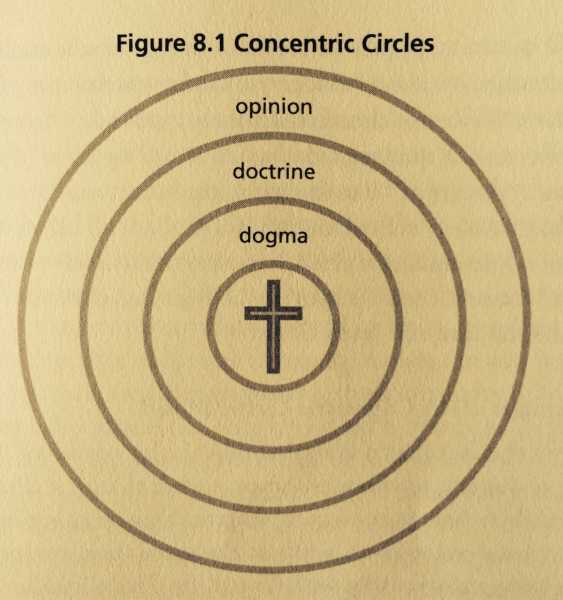
Let me give you a paradigm in which we can think through or process our theological ConcentricCirclesTheology2thoughts using 3 concentric circles. I am borrowing this diagram from author and pastor Greg Boyd. I have read some of his books and listened to his podcast for years and this concept has really helped me out a lot in processing my thoughts.

In the center of this diagram is JESUS. He perfectly embodies the love of God for us and he models the type of love that we ought to have for him and for each other. He is the means whereby we experience the love God has for us.

The next circle is labeled DOGMA. These are the beliefs of the church that make us distinctly Christian. Many of these beliefs are reflected in the creeds of the church such as The Apostle’s Creed. The belief in the Trinity, and also the humanity and divinity of Christ would fit this category. These are like the non-negotiables that define Christianity.

The next circle is labeled DOCTRINE. These are important beliefs that we have but may have different views. Many denominations have different views on what exactly happens in the sacrament of communion, how it should be performed and who can participate. Some denominations believe that God is involved in every detail of life while others believe that there is some degree to free will.

And the final circle is labeled OPINION. This circle represents different ways in which we may interpret particular doctrines, such as how to interpret the Creation story in light of evolution, and there are different views on how to understand the atonement, the afterlife, the apocalyptic literature such as the book of Revelation and on and on.

Notice in this diagram that Christ is always central. His love for us and our love for each other. That must be the most important thing. The wrestling match comes when we try to determine what is dogma, doctrine or just opinion. Regardless of whatever issues we may be struggling with as a church we need to always keep Christ central.

So, at this point, I would challenge all of you to take an assessment of your life and make sure you are not getting caught up in the divisiveness of our culture, with all the hate and anger that is out there, but instead we learn how to be more and more like Christ through our love for God and our love for each other. We must make sure that we are connected to the vine and that we are demonstrating the fruit of love in our growth as a Christian. Always keep the main thing, the main thing.

Dr. Martin Luther King, Jr. once said, “Darkness cannot drive out darkness; only light can do that. Hate cannot drive out hate; only love can do that.” So, let’s make sure that our faith is centrally located in the love of God and the love for each other. This is the one and only way that we will stand out as kingdom people and rise above all the hostilities that divide and label others. Love one another. This is not an opinion but what is central to our faith. Let us love one another. Amen.


Reflections on The Prophets

prophets1I just finished reading through the prophets in the Old Testament. What made an impression on me was the way in which God held whole nations accountable for their actions. He held them accountable for their violence, their greed, and how they treated their own people as well as other nations. Special care was directed at the people on the fringe: the alien, the stranger, the poor.

Reflecting on this, it scares me how God must view America right now. What we have done at the border separating families and abusing kids is reprehensible. Nationalism has risen it’s ugly head and become it’s own religion. The idea of “America First” flies in the face of Jesus’ teaching that the first will be last and the last will be first. The idea that we are a “Christian Nation” is really laughable. America needs prophetic voices to call out injustice and hypocrisy right now. Unfortunately over 70% of evangelical Christians approve of where we are politically. Then there are churches who do not connect the dots from Scripture to our modern day problems as a nation. Instead they preach a Gospel devoid of justice. To show any type of criticism toward our nation could alienate you from a percentage of your audience. But we need prophetic voices that call out the injustices that are happening right under our noses. A church that just preaches a feel-good message without ever calling for justice is the very thing that some of the false prophets throughout the Old Testament were called out for and were held accountable.

I worry about the American Church. It has become seduced with political power and has mixed religion with nationalism. This is just out-right idolatry. We are guilty of some of the very same sins that Israel was guilty of and were held accountable for throughout Scripture. And to think that there are those who believe that our religious freedoms are under attack. Once again, we need to look at all the examples throughout Scripture and history of those who were really persecuted and executed for their faith. That was real persecution. Yet story after story you see how God brings beauty out of the ugliness of Christian persecution. They were willing to suffer and be executed for their faith. Yet in our country we are told we can now say “Merry Christmas”. Really? Was that really a thing?

It is time for an Awakening. For a new generation of Christ-followers who love God and love people, but are also willing to call out injustice and seek ways to mobilize the church to be more prophetic. These are dark times we are living in yet either we are oblivious to it or we are complicit as we praise our national leaders, demand our rights, and demand that we are first. I honestly wrestle with what I am seeing with our nation as well as the contemporary church. It is ironic that we live in the information age yet the church is becoming more and more biblically illiterate. We want our own personal Jesus that makes us feel good about ourselves but we ignore the God who holds nations accountable for their sins. It time for the church to revisit the Prophets and realize that we have a responsibility to care for the alien, stranger, poor, outcast, the people on the fringes. We need to get back to reaching out instead of protecting the base. The church ought to be the consciousness of the nation, not a complicit partner with the nation.

There is a reason why so many people are walking away from the American Church and I believe that one of those reasons is that we have become irrelevant. We are not seeking justice, we are not offering mercy and we certainly are not acting humble. We have drifted a long way from what Scripture teaches us. May God have mercy on us and may his Spirit awaken us to the truth.