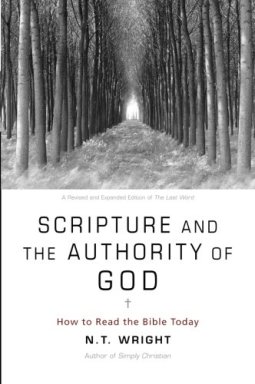
 Now I know that my “book reports” are more of a recap of what I read, more than a review. I typically read books I know that I will most likely enjoy. So when I do a blog on a book I want to capture the basic idea of the book along with my favorite quotes. I hate when I read a book, like it, and then 3 months latter I can’t remember much about the book. So I like to use blogging as my way to remember my favorite parts of the book. This blog is on one of my favorite authors.
I love reading anything by N.T. Wright. Let me just get that out there right away. He is our modern day C.S. Lewis. He is certainly one of my favorite authors and had contributed a lot to my theology. I enjoyed this book as it explored how we look at Scripture throughout different stages of time all the way up into Post-modernity.
Wright begins by establishing by what authority Scripture ought to speak to us. He states that “When John declares that ‘in the beginning was the word,’ he does not reach a climax with ‘and the word was written down’ but ‘and the word became flesh.’ . . . scripture itself points – authoritatively, if it does indeed possess authority! – away from itself and to the fact that final and true authority belongs to God himself, now delegated to Jesus Christ.” (p. 22). Authority is found through the life of Christ of which Scripture points to. Wright continues that “self-revelation is always to be understood within the category of God’s mission to the world, God’s saving sovereignty let loose through Jesus and the Spirit and aimed at the healing and renewal of all creation.” (p. 29).
Wright goes on to explain the relationship of Jesus to Scripture. He says that “Jesus was the living embodiment of Israel’s God, the God whose Spirit had inspired the scriptures in the first place. And if he understood his own vocation and identity in terms of scripture, the early church quickly learned to make the equation the other way as well: they read the Old Testament, both its story (including covenant, promise, warning, and so on) and its commands in terms of what they had discovered in Jesus.” (p. 43). So the life of Jesus is the grid in which we go back and interpret all of Scripture. Jesus is the culmination of what all of scripture was leading up to.
Wright then goes into various ways that the church has interpreted scripture throughout history. As he talks about the impact of the Enlightenment, Wright explains that “Much would-be Christian thought (including much would-be ‘biblical’ Christian thought) in the last who hundred years has tacitly conceded these huge claims, turning ‘Kingdom of God’ into ‘the hope for heaven after death’ and treating Jesus’s death, at the most, as the mechanism whereby individual sinners can receive forgiveness and hope for an otherworldly future – leaving the politicians and economists of the Enlightenment to take over the running, and as it turns out the ruining, of the world. (This political agenda, by the way, was of course a vital part of the Enlightenment project: kick ‘God’ upstairs, make religion a matter of private piety, and then you can organize the world to your own advantage.)” (p. 89). We have lost sight of what it means to be kingdom people right here and now in all areas of our lives.
Wright continues in his argument against the effects of the Enlightenment on our interpretation of Scripture by saying that “To affirm ‘the authority of scripture’ is precisely not to say, “We know what scripture means and don’t need to raise any more questions.’ It is always a way of saying that the church in each generation must make fresh and rejuvenated efforts to understand scripture more fully and live by it more thoroughly, even if that means cutting across cherished traditions. (p. 92). I fully agree with this in that each generation needs to be responsible in looking at scripture with fresh eyes in how it speaks to us today.
Wright then goes after postmodernity stating that “Postmodernity’s effect on contemporary Western readings of scripture is thus, as with much else in the movement, essentially negative. Postmodernity agrees with modernity in scorning both the eschatological claim of Christianity and its solution to the problem of evil, but without putting any alternative in place. All we can do with the Bible, if postmodernity is left in charge, is to play with such texts as give us pleasure, and issue warnings against those that give pain to ourselves or to others who attract our (usually selective) sympathy. This is where a good deal of the Western church now finds itself.” (p. 98). I would agree also that we need to be aware of how postmodernity affects our thinking for good or ill. We need to be able to look back on how people in the past interpreted scripture in light of the cultural and philosophical influences that would shape how they would think.
After his critiques of how scripture is being interpreted Wright positively says that “Genuine historical scholarship is still the appropriate tool with which to work at discovering more fully what precisely the biblical authors intended to say. We really do have access to the past; granted, we see it through our own eyes, and our eyes are culturally conditioned to notice some things and not others. But they really do notice things, and provided we keep open the conversation with other people who look from other perspectives, we have a real, and not illusory, chance of finding our more or less what really happened. (p. 113). I agree here that it is important to be in dialogue with others that come to the understanding of scripture from different perspectives. This helps to challenge, critique and possibly strengthen our original thoughts on scripture. It is not healthy to be in an echo chamber where everyone agrees with everything you believe Scripture to say. It is through others experiences and other perspectives that we can get a fuller understanding of Scripture and maybe even see things that we did not originally see for ourselves.
Wright points our that “We read scripture in order to be refreshed in our memory and understanding of the story within which we ourselves are actors, to be reminded where it has come from and where it is going to, and hence what our own part within it ought to be. This means that ‘the authority of scripture’ is most truly put into operation as the church goes to work in the world on behalf of the gospel, the good news that in Jesus Christ the living God has defeated the powers of evil and begun the work of new creation. It is with the Bible in its hand, its head, and its heart – not merely with the newspaper and the latest political fashion or scheme – that the church can go to work in the world, confident that Jesus is Lord and Caesar is not.” (p. 116). Unfortunately, at this moment in time we as a nation seem to like Caesar over Christ and it is hurting the church in ways we will never fully understand until decades from now. American evangelicalism has gotten infatuated by political power over the mission of the church. My rant is over.
Wright then goes on to explain how we get back on track in that “if we are to be true, at the deepest level, to what scriptural authority really means, we must understand it like this: God is at work, through scripture (in other words, through the Spirit who is at work as people read, study, teach, and preach scripture) to energize, enable, and direct the outgoing mission of the church, genuinely anticipating thereby the time when all things will be made new in Christ. At the same time, God is at work by the same means to order the life of the church, and of individual Christians, to model and embody his project of new creation in their unity and holiness.” (p. 138). I love that Wright sees the project of new creation as our mission right now! It is not our job to just wait until the afterlife. It is our job now to be kingdom people and to live into that right now.
Wright wraps up his book in stating that “The various crises in the Western church of our day – decline in numbers and resources, moral dilemmas, internal division, failure to present the gospel coherently to a new generation – all these and more should drive us to pray for scripture to be given its head once more; for teachers and preachers who can open the Bible in the power of the Spirit, to give the church the energy and direction it needs for its mission and renew it in its love for God; and, above all, for God’s word to do its work in the world.” (p. 141). We must have a high view of scripture and its effect and impact on others when used appropriately.
As I have said before, I love N.T. Wright and I highly encourage everyone to read anything he has written. He is one of the greatest thinkers of our day and age. This book empowered me to see the importance and primacy that scripture should play through my life and through the church. It is important that we wrestle with scripture using our ability to reason, consider what tradition has taught us, and wrestle with other’s experiences to help us better understand it. He wraps up his book by doing two case studies; one on sabbath, and the other on monogamy.
 When I was in high school I still remember taking my girlfriend (who is now my wife) to go see a movie at the local mall. All I knew about the movie was that it was a Steven Spielberg movie starring Michael J. Fox. These were two very good reasons to see a movie in 1985. Little did I know what I was in for. It turned out to be one of my favorite ‘80’s movies. The concept of going back in time 30 years to help change the future was a great concept. Of course, Marty McFly was trying to help his parents who were teenagers in 1955. But I often wonder, what would I do if I could go back 20-25 years and find the young version of myself just starting out in ministry. Knowing what I know now, what would I say to the 1990’s Scott just starting out in youth ministry?
 Once again, I heard a great speaker at the Global Leadership Summit back in August 2018. They so inspired me to go out and buy some of his books! This one is called “Start With Why: How Great Leaders Inspire Everyone to Take Action” by Simon Sinek. It was a great read in explaining how great leaders start with the “why” when it comes to being successful. So many businesses start with what they do and how they do it without wrestling with why they do what they do. When you discover your “why” that will help to inspire and empower the people who work for you. And the answer to WHY is not just about making money. It is about what inspires people to want to give their best effort towards your cause.
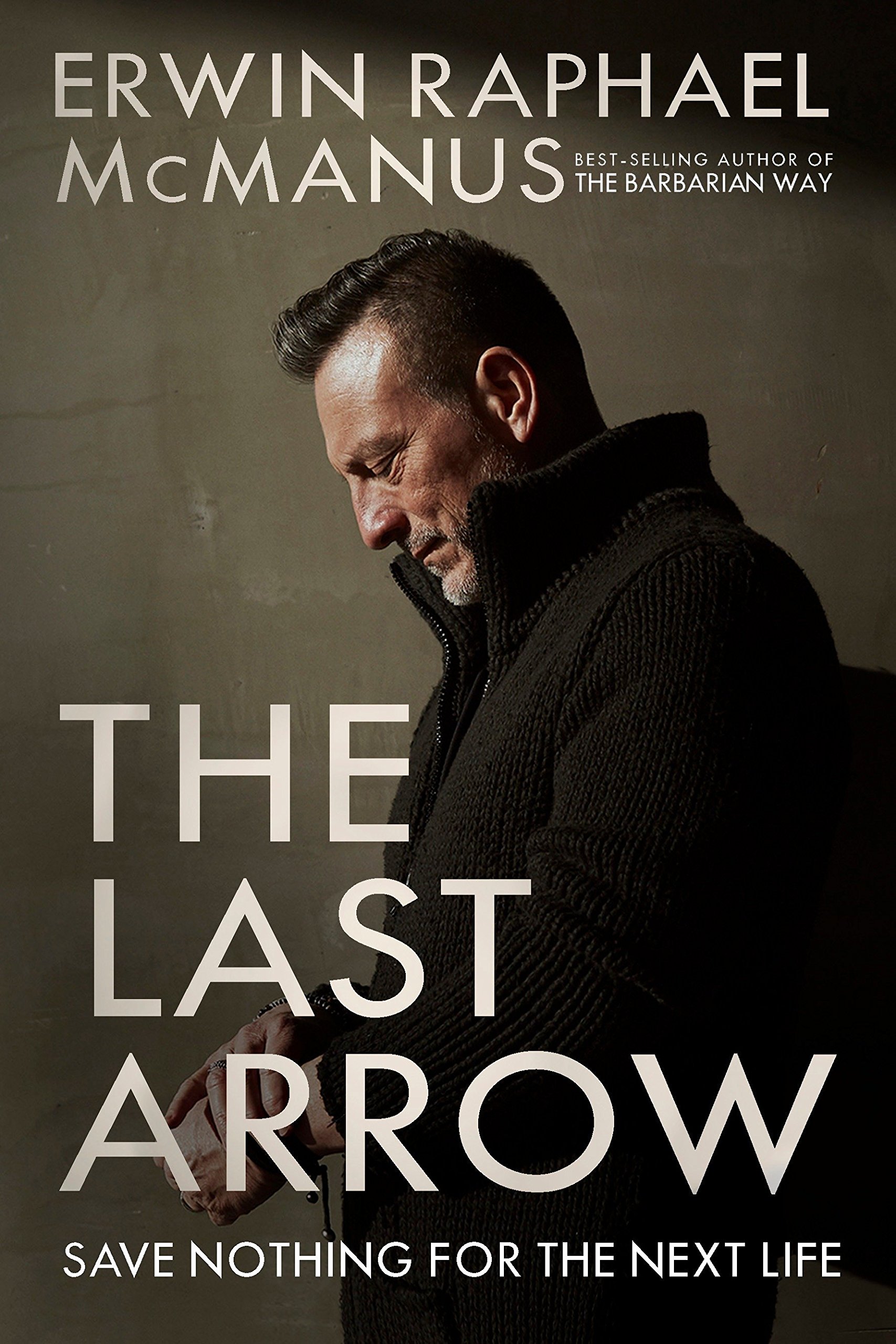 I heard Erwin McManus for the first time at the Global Leadership Summit in August 2018. He was by far, the most passionate and dynamic speaker of the whole event. He spoke about the fact that he was diagnosed with cancer a while back. As a result of his battle with cancer, this has helped to put things into better perspective as to living his life in order to make the most impact possible.
 There is enough negativity out there directed at youth ministry that when I saw the title of this book I knew I just had to get it! Mark Oestreicher has been in the “business” for quite a while now. I have aged in my ministry to youth following the career and writings of Marko. And just about anything he has written on the topic of youth ministry has been very thought provoking and enlightening.
 Lately I have been feeling a little discouraged when it comes to my ministry. Not a big deal, nor is it something I really want to get into here, but I do want to share some God moments I have had over the past week where God clearly showed Himself to me as an encouraging sign that things are happening with our youth.
 What happens when God messes up your comfortable Christian life? Author Jen Hatmaker takes you on a personal journey of how God did just that for her and her family. She begins by recognizing the facts about poverty around the world in contrast to a comfortable Christianity that so many of us practice. Through the influences of Shane Claiborne writings, and the promptings of the Holy Spirit, Jen was challenged to step out of her comfort zone and let her faith get messy. She states that “I am still stunned by my capacity to spin Scripture, see what I wanted, ignore what I didn’t and use the Word to defend my life rather than define it.” (p. 5). The sad fact is that I believe that many American Christians do approach their faith like this. Jesus came to radically change our lives. Too often we want Jesus in our lives but on our terms, not His. We don’t want Him to ruin the life we have created for ourselves. Jen points out that “Americans living in excess beyond imagination while the world cries out for intervention is an unbearable tension and utterly misrepresents God’s Kingdom.” (p. 31). Jen balances this out though, not trying to lay a big guilt trip on her readers, but instead she is trying to wake us up to many of our realities. Jen comments “Please don’t hear me say that America stinks and all her citizens are narcissists. It’s just that most of us have no concept of our own prosperity. Nor do we have an accurate understanding of the plight of the rest of the world. Our perspective is limited, and our church culture is so consumer oriented that we’re blinded to our responsibility to see God’s kingdom come to ‘all nations’. . . . We stand at the intersection of extreme privilege and extreme poverty, and we have a question to answer: Do I care?” (p. 34-35).
 Scott Russ