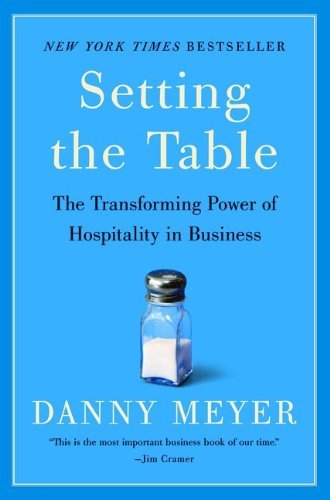
When I think of visiting New York City I often think of Broadway productions I want to see. But after reading Danny Meyer’s “Setting the Table” I now want to visit NYC just to try out his restaurants. Unbeknownst to me, the last time I was there I did go to a Shake Shack not realizing the story behind the restaurant.
I first heard Danny Meyer at the Global Leadership Summit back in August of 2018. He struck me as a very dynamic and inspiring speaker which lead me to buy his book. This should be required reading for anyone in the hospitality business as well as churches. My grandmother used to have a cross-stitch frame that said “You never get a second chance to make a first impression.” This book hammers that point hard. Churches need to consider what a visitor’s first impressions might be upon visiting the church. If there is no initial hospitality, chances are that person may never return again.
There was so much in this book that I enjoyed, but I also felt that, although the church does not fall into the restaurant business, there is a lot to learn here about hospitality and leadership and how we can apply it to our context.
One thing that impacted me was Danny’s use of the 51% rule. What he meant by that is that he would hire people that were 49% skills and 51% character and people skills. Danny states that “far more important to me than a friend’s skills was always his of her goodness as a person. . . . I want the kind of people on my team who naturally radiate warmth, friendliness, happiness, and kindness. It feels genuinely good to be around them. There’s an upbeat feeling, a twinkle in the eye, a dazzling sparkle from within. I want to employ people I’d otherwise choose to spend time with outside of work. Many people spend a large percentage of their waking hours at work. From a selfish standpoint alone, if that’s your choice, it pays to surround yourself with compelling human beings from whom you can learn, and with whom you can be challenged to grow.” (pp.142-144). In the context of the church, I believe that this is true for those on staff and leadership. Skills can develop and be taught, while heart and people skills are at least 1% more important.
Danny believes in servant leadership as a bottom-up manager. He makes the point that “An organization puts itself in grave danger when it permits integrity to be compromised.” (p. 198). While this may apply to management, waiters and cook, I believe that this is essential for the church. It is imperative that a church staff and leadership have integrity and a servant-leadership model toward the rest of the congregation. In modeling this, we hope to empower the congregation toward love and good deeds!
Another great chapter in Danny’s book dealt with how you handle problems. Danny comments that “the secret of the game is anticipating mistakes, harnessing them, and addressing them in constructive ways so that we end up in a better spot than if we had never made them in the first place.” (p. 221). He gave a lot of great illustrations in which costumers had a mistake occur, and then how the management of the restaurant didn’t allow the mistake to define their experience, but found a way to go over and above in creating a positive outcome that would overcome the mistake. This can be done in the context of the church with a simple phone call, visit, or letter.
In the context of church it is important that we are hospitable, that we empower people to live into being a child of God, and that we lead with integrity. Granted, in a good church, this will not necessarily apply to the sermon because the job of the pastor is to teach the Bible within the context of our lives today and I know sometimes that can leave a person feeling really good, or convicted, or angry because they are not ready or willing to receive the message. But in the context of first impressions, we should absolutely have a hospitality team that helps people feel recognized and important. We should expect high moral integrity from our leaders which should inspire the rest to live better lives. And we should look to make difficult situations better with real conversation, warmth and kindness.
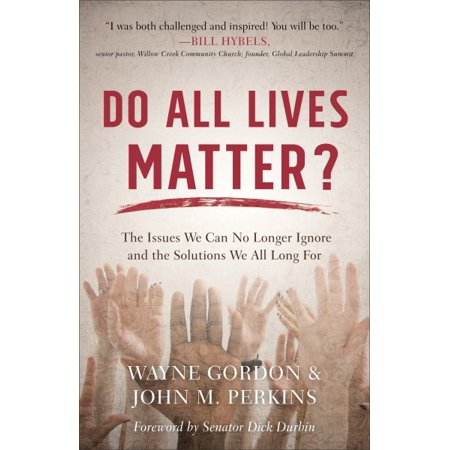 Do all lives matter? The answer seems easy. All of us would say that all lives matter. And the fact is, you would be right. But the reality that we live in today does impose a hierarchy signifying that certain lives matter more than others. Throughout American history we have seen many times in which certain people’s lives were seen as less significant than others. This is the heart of what John Perkins is getting at in his book “Do All Lives Matter?” John states early in the book that “if we are going to make progress with regard to behaving as if all lives matter, we need to make a genuine effort to understand others and the realities and struggles they face.” (p. 25).
 If anybody is paying attention to the news in politics and faith it is quite certain that we are in a crisis right now. I wasn’t old enough to remember the Nixon administration but I believe that we are in a much more critical point in our history right now. Our government is caught up in one scandal after another. And this is not just typical politics. This is a crisis of integrity, leadership and ethics on a scale I have never seen before. But then we look at the church and in several pockets we see the same type of crisis playing out. Willow Creek, a very influential church to the global church community, is in one of their own scandals as well as the Catholic church having yet again another pedophile ring that was covered up. This is not about being a republican versus a democrat or a protestant versus a Catholic. Instead, what I am seeing is a massive failure of leadership on a national scale. Our government is a mess, (and if you don’t believe that your ignoring facts and labeling it as fake news), and I would say the church in America is a mess also.

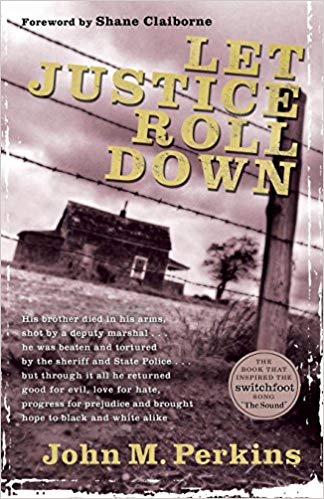 I am a big Switchfoot fan. I have loved their musical throughout the time I have been in ministry. It has been fun to see them evolve as artists. But there was one song that stuck in my head called “The Sound”. The reason was because of this lyric:
 I just finished reading through the prophets in the Old Testament. What made an impression on me was the way in which God held whole nations accountable for their actions. He held them accountable for their violence, their greed, and how they treated their own people as well as other nations. Special care was directed at the people on the fringe: the alien, the stranger, the poor.
 Do we worship a schizophrenic God? A flat reading of the Bible seems to suggest that.
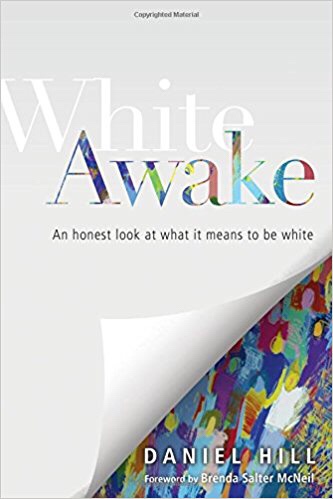 I recently read “White Awake: An honest look at what it means to be white” which helped to bring much clarity to issues within our country related to race. Author Daniel Hill begins by telling his story on how he wanted to create a multi-ethnic church in Chicago. While he had good intentions, the results for diversity were abysmal. Much of his congregation was just as white as he was. In attempting to find out why he was unable to attract a multi-ethnic crowd he decided to visit with a hand full of local non-white clergy. In doing so, he was humbled to realize how little he knew about culture that impacted people of color. His mentors exposed the fact that almost every possible influence in Daniel’s life was from white culture. Daniel realized quickly that people of color have many different experiences as a minority culture in contrast to the dominate influence of white culture in America. What seems normal to most white people is not necessarily what people of color experience. All throughout our 200+ history people of color have been judged as “less than” in comparison to white culture. Daniel states that “When the journey begins to feel like any combination of scary, confusing, disorienting, or even painful, we have a privilege that people of color do not: we can walk away; we can go back to ‘normal,’ if we choose.” (p. 38)

 Scott Russ